Cincinnati enters a new era amid the rapid evolution of college athletics
With the landscape of college athletics transforming more than ever, the University of Cincinnati has not only had to navigate new rules and regulations, but also a transition into a new conference.
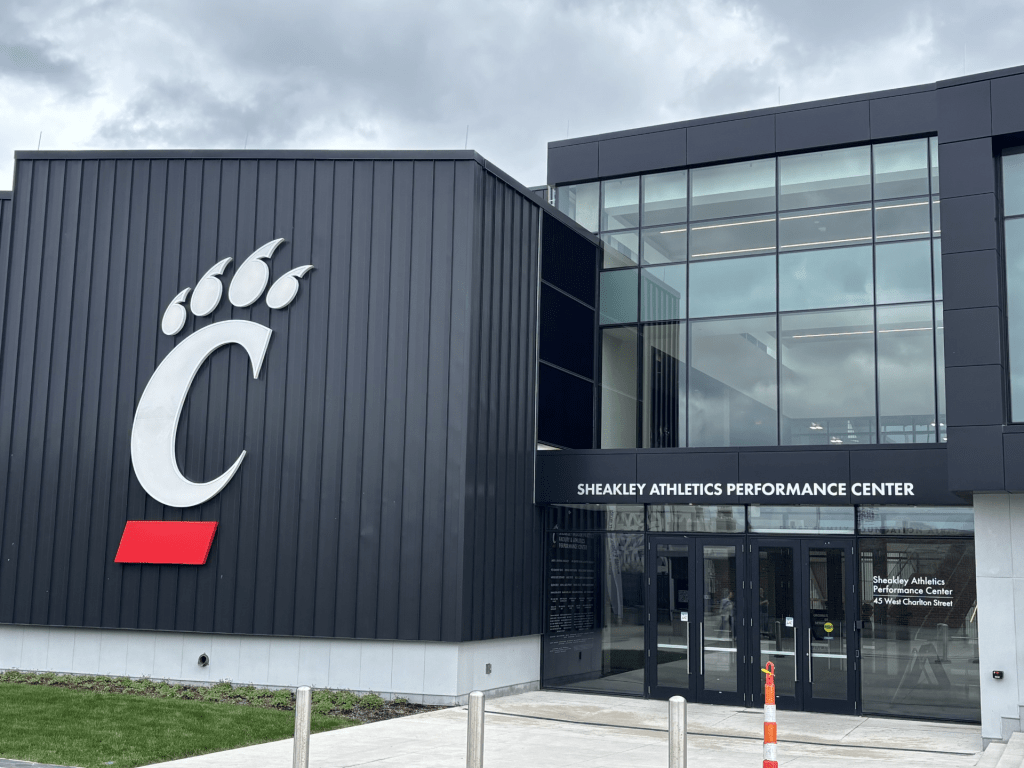
| Located on the southeast corner of campus, the new Sheakly Athletics Performance Center offers all athletes at the University of Cincinnati an indoor practice facility and all the amenities they need to thrive. Photo: Austin Bass |
By: Austin Bass
College athletics are undergoing one of the most dramatic transformations in modern history, and money is at the forefront. For years, the structure surrounding the NCAA and its athletic programs remained relatively stable. A student-athlete committed to a school and often stayed at the same institution for all four years of their collegiate career. Coaches developed rosters over time, recruiting classes were expected to grow together, and programs relied on continuity. With recent developments and newly introduced policies, however, the landscape of college athletics has become far more uncertain and competitive.
Student-athletes can now profit from their own name, image and likeness (NIL), allowing universities and outside collectives to create compensation opportunities that can influence a player’s decision to attend a particular school. Athletes can pursue endorsement deals, sponsorships and personal branding opportunities while maintaining their collegiate status, empowering them financially in ways never before possible. While NIL has created opportunities for athletes, it has also led to concerns over competitive balance and has contributed to a growing trend of athletes leaving one program in search of a more lucrative opportunity elsewhere. That shift has helped make another major development even more significant: the transfer portal.
The transfer portal has made movement from school to school more common than ever, allowing student-athletes to explore opportunities elsewhere and, in many cases, compete immediately at their new institution without sitting out a season. This increased freedom gives athletes more control over their careers, whether they are seeking more playing time, a better fit or stronger financial opportunities. For coaches, however, it has made roster management more difficult than ever. Programs must now recruit high school prospects while also constantly monitoring current players across the country.
At the same time, eligibility standards have become more flexible. The COVID-19 pandemic granted all student-athletes an additional year of eligibility, and when combined with redshirts and medical waivers, some athletes can remain in college athletics for seven or even eight years. This creates older, more experienced rosters and forces programs to carefully balance veteran players with incoming recruits.
Universities across the country have had to adapt quickly as these new realities reshape college sports. The University of Cincinnati faces these same challenges while also navigating the move into the highly competitive Big 12 Conference. As the Bearcats continue adjusting to a tougher league and a rapidly changing national environment, the decisions made by Cincinnati’s athletic leadership will play a major role in determining the future success of its programs.
The Move to the Big 12
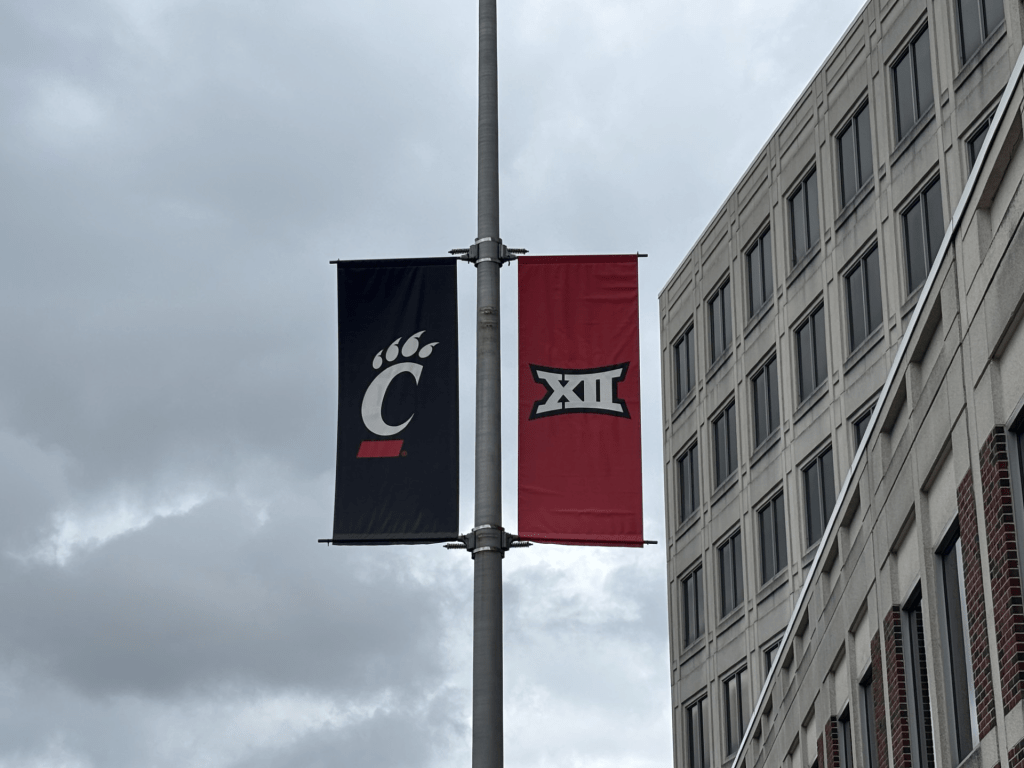
| Flags of the Cincinnati “C-paw” logo and the Big 12 logo flying side-by-side around campus, signifying the university’s invitation and move to the new conference. Photo: Austin Bass |
Cincinnati has spent time in many different athletic conferences throughout its history. The Bearcats were members of the Great Midwest Conference, Conference USA, the Big East and, most recently, the American Athletic Conference before joining the Big 12 Conference in July 2023, along with fellow AAC schools Central Florida and Houston and BYU. This marked Cincinnati’s first time in a Power Four conference, the most competitive and well-funded tier in the country, consisting of the Big Ten, Big 12, Southeastern Conference (SEC) and Atlantic Coast Conference (ACC).
The transition to a Power Four conference from a Group of Five, or mid-major, conference is not an easy one, and Cincinnati’s performance in the three major sports showed that. Football finished 1-8, basketball finished 7-11 and baseball finished the best at 17-15 in Big 12 play.
“I think it’s incredibly difficult for a school and an athletic department,” Cincinnati football general manager Zach Grant said. “There are certainly some exceptions and cases where teams hit the ground running right away, but if you look at the history of schools that have gone from a non-power league to a power conference, it takes a while to really get going.”
“The expectations are growing, and there’s pressure that comes with that, but we are also just trying to remind them that, hey, we play a game that’s supposed to be fun,” assistant baseball coach and lead recruiter Kyle Pettoruto said. “That’s what it is all about at the end of the day.”
Pettoruto’s mindset and message to the team may have contributed to the baseball program’s success in its first season in the Big 12, which was also his first season with the team. The 2023 season marked Grant’s first year as general manager after he had stints at Western Kentucky and Ohio State in the recruiting department.
Better competition isn’t the only thing a school gets by joining a Power Four conference. Perhaps more importantly, revenue sharing and funding take a significant leap. The Big 12 ranked near the top of all conferences in revenue sharing for the 2025-26 fiscal year. While the Big 12 itself received substantial revenue for the year, Cincinnati still sits toward the bottom of the conference in both earnings and spending as a newer member.
Cincinnati, like every other school, is looking to gain an edge in recruiting, and receiving a full share of the Big 12’s revenue starting this year has given the Bearcats a much-needed boost to the NIL fund for all major sports. That’s a good start, but the university has pushed additional initiatives to put itself in the best possible position to sign top players and compete at the highest level.
The New Age of Recruiting with NIL

| Cincy Light, a beer created for the sole purpose of providing NIL funding to Cincinnati athletes through a partnership between Cincy Reigns and Rhinegeist. Photo: Austin Bass |
NIL has completely changed the game when it comes to recruiting both high school prospects and veterans out of the transfer portal. Introduced in July 2021, the policy allows athletes to profit from their name, image and likeness, but it quickly became controversial as universities and boosters began paying players directly. Most people around college athletics believe the policy can be positive for everyone if more regulations are put in place.
“I think the money might be a little bit too much, to the point where it’s crazy that you’re having guys who are turning down the NBA for six to eight times more payout in college,” Cincinnati basketball general manager Corey Evans said. “I worry about what that could mean for the mental state of a person four or five years down the road.”
Regulations would not only keep players from making over a certain amount themselves, but also would cap the amount each school can spend to build its rosters for each sport. In turn, competitive balance would be restored, and there wouldn’t be as large a disparity from top to bottom in Division I college athletics.
“Ultimately, I’d love for somebody to get involved, whether that’s the government or Congress,” Pettoruto said. “I’ve heard whispers about possibly getting involved to make it more of an even playing field for everybody, and I would love for that to happen.”
While rumors and conversations continue on the topic, there have been no official changes to the NCAA’s NIL policy. President Donald Trump issued an executive order at the beginning of April aimed at forcing the NCAA’s hand in regulating its own rules. With no changes in place, Cincinnati’s athletic programs continue to find new ways to adapt to the art of recruiting talent from high school and the transfer portal.
Cincy Reigns, Cincinnati’s NIL initiative, was created by alumnus Brian Fox to help fund all Bearcats athletes. Cincy Reigns partnered with Rhinegeist to create Cincy Light, a locally brewed beer that gives back a small portion of each sale to Cincinnati athletes. Fox has provided funding for figures like Grant, Evans and Pettoruto to compete at the highest level in the Big 12 through the nonprofit.
Even with all the money involved, the three agree that building relationships must be at the forefront of selling the school to a recruit. Money may be at the top of most recruits’ minds when it comes to committing to a school, but it won’t matter if a relationship isn’t built first. Recruiting departments now face situations where a program wants a player but won’t offer as much as the player believes he is worth or as much as another program believes he is worth.
It’s no longer a simple offer-to-commitment timeline. There is now the potential for negotiations and for players to leverage schools against each other in order to secure the best offer.
“Now we’re talking about investing money into a player, so it’s no longer just like, ‘OK, we all kind of like him enough. Let’s offer him now,’” Grant said. “It’s like, ‘OK, how much exactly do you like this guy? How do you value him? What do you see his role being in his projection, and how long is it going to take?’
“Everybody has a say in that, and it has become more important. So we need to be more intentional throughout the entire process of making sure that happens,” Grant said.
The introduction of paying players has also led to contract disputes between players and schools, and Cincinnati experienced that firsthand with former quarterback Brendan Sorsby. Sorsby played two seasons for the Bearcats before transferring to Texas Tech, but he reportedly signed a two-year NIL deal before the 2025 season with a clause requiring him to pay the university $1 million if he left early.
First reported by Justin Williams of The Athletic, Cincinnati filed a lawsuit to pursue the $1 million it says it is owed by its former quarterback. The process is ongoing as of April 30. Grant declined to comment on the situation specifically, but said there will be challenges with any new system introduced to college athletics.
“I think, like anything else, there are always changes that can be made to make something work better, but it’s so nuanced with NIL, and there are so many hoops to go through to get what people would consider a correct change, right?” Grant said. “I don’t have those answers, so while there are potentially things that could improve it, I’m a fan of how it works because it’s what we have. If I complain about it all the time, I’m not going to do my job.
“I need to embrace it and try to figure out a way in the era that we’re in and within the rules to have Cincinnati be as successful as possible.”
Sorsby’s transfer to Texas Tech created controversy on the NIL front, but the transfer portal has caused far more confusion and debate than that.
The Unfolding of the Transfer Portal and Eligibility
| A gate, signifying the continuous flow of student-athletes from school to school around the country through the transfer portal. Created by: Austin Bass with help from AI |
The current transfer portal has been in place since 2018, replacing the old system that required players to ask permission to speak with specific schools. The new, streamlined process gave players more autonomy to declare their intent to transfer and allowed coaches to see available players in real time.
Until 2024, this version of the transfer portal allowed student-athletes one free transfer without a loss of eligibility. Now, players can transfer as many times as they want without the threat of losing eligibility. This year alone, more than 10,500 players across all three divisions of college football entered the transfer portal, setting a record for the most since it was introduced.
College sports used to center on watching players grow with a program for four years and graduate from the same school where they started, but that has become almost unheard of over the last few years.
The NCAA has since introduced a new “5-for-5” rule, giving players five years to play five seasons of a sport with one free transfer. It is not expected to be officially voted on and enforced until the fall, but it appears to be a step in the right direction to address the mass exodus of players and eligibility concerns created by the current policy.
Coaching staffs and recruiting departments have had to adapt their methods of building rosters, deciding whether to prioritize the transfer portal and bring in experienced players from other schools or remain committed to developing mostly high school recruits. All sports have different needs and philosophies when it comes to roster construction.
Evans and the rest of the basketball staff have said they prefer to bring in a freshman class each year, but a majority of their needs will be addressed through transfers.
“I think it’s definitely the pro model,” Evans said. “I’m not going to say it’s the NBA model, but I would say as far as paying players and the infrastructure with the transfer portal, with the front office and basketball coaching staff, it’s getting close. You now have this infusion of pro experience because the game is getting closer and closer to the pro model.”
Grant and Pettoruto, on the other hand, want to focus more on bringing in high school talent that fits the culture of the program and can be developed into key contributors in the future.
“Our philosophy is to recruit a full high school class every single year, and by full, I mean we’re going to start with 11 starters on each side of the ball,” Grant said. “So that’s going to look around 22, and then based on what we did or didn’t do in the class before, it may be a few more or a few less.”
“The freshmen who are here now, the 2025 class, were the first class that we were able to build start to finish,” Pettoruto said. “We said once that class arrives, the portal is just going to become plug-and-play. We’ve kept our word — last year, we led the Big 12 in the fewest transfers.”
More high school recruits help teams avoid concerns about a player’s eligibility, and there are more questions than answers as to why some players receive a certain number of years while others receive more. Players are getting a seventh or eighth year of college basketball and competing as 24-year-olds who haven’t taken a single class in two years.
Even more egregious are players, particularly in basketball, entering the NBA draft and signing G League contracts, then attempting to return to college. First reported by Myron Medcalf of ESPN, former Alabama forward Charles Bediako sued the NCAA in January 2026 to become immediately eligible for the Crimson Tide and played five games before a judge denied his injunction request, ending his eligibility.
“Even over the past three months, the players that we’ve seen coming to the college space, whether it’s James Nanji at Baylor, Charles Bediako at Alabama, and now Amari Bailey potentially returning to college next year, these guys have played or entered the NBA ranks and tried to get drafted. Some did get drafted, some received real NBA contracts, and to come back and hopefully return to college basketball,” Evans said.
“It just goes against everything that we’re accustomed to seeing in college sports over the past 100 years, so you’re trying to really figure out what rules are going to stick.”
With “5-for-5” likely to pass over the summer or in the fall, the headache of roster construction can be mitigated in the coming years.
Building for the Future

| UC Baseball Stadium, Fifth Third Arena and Nippert Stadium, the homes of Cincinnati’s athletic programs, are all located within a short walk of each other in the middle of campus. Photo: Austin Bass |
The transition to the Big 12, along with other outside factors, hasn’t been easy for Cincinnati, but those in charge have the Bearcats on an upward trajectory.
Football has increased its win total in each of the last three seasons and cracked the AP Top 25 in 2025 before losing its final five games to finish 7-6. With a solid freshman and transfer class on campus for the upcoming season, the program looks to take another leap in 2026.
“Growth financially, I would say, is the biggest growth that I’ve seen just from the amount of money we’ve been able to put into the roster through NIL and revenue sharing year over year. Then our facilities are just a drastic change from where they were to where they are now,” Grant said.
“I’d also say our players and the body types we have, like how big and fast we are relative to 2023, is a gigantic change. We kind of now look like a Power Five team, and that took a gradual amount of time to really get there where I feel confident saying that.”
Basketball recently hired Jerrod Calhoun as its new head coach, and the program is filled with optimism that he can hit the ground running. Calhoun, along with Evans, has put together a top-25 transfer class for the upcoming season as the program looks to make the NCAA Tournament for the first time since 2019.
“I understand Bob Huggins had such great success in the 2000s, and I understand Mick Cronin had such great success in the 2010s, but we’re actually writing a new story here in the Big 12,” Evans said. “It’s kind of a new day, a new age, and having the chance to rewrite some things here in such a different place and in a brand new league, the Big 12, with the teams that are in it, is fascinating. I think that the reason we have a chance to have that success is because of the infrastructure and support of this university.”
Baseball has had the most success among the three major programs at Cincinnati and currently holds a spot in the NCAA Tournament. Its leaders? Two sophomores recruited out of high school. Head coach Jordan Bischel and Pettoruto have revived the once-struggling program and have it on an upward trajectory in year three.
“You could find holes wherever you want in any program that you’re around,” Pettoruto said. “We don’t forget where we were when we walked in the door to where we are now. It’s crazy, man. It’s been awesome. John Cunningham has been incredibly supportive. For us, we have to hold up our end of the bargain and put out a good product and win a lot of games. So hopefully we can keep doing that.”
The landscape of college athletics will continue to evolve, and schools will keep adapting to each change the NCAA presents. With Grant, Evans and Pettoruto at the helm, Cincinnati looks to compete for championships at the highest level in the near future.
Source List:
Kyle Pettoruto – Cincinnati Baseball Assistant Coach and Director of Recruiting – quotes from Pettoruto came from my interview over the phone with him on February 5
Corey Evans – Cincinnati Basketball General Manager – quotes from Evans came from my in-person interview with him on February 9
Zach Grant – Cincinnati Football General Manager – quotes from Grant came from my interview with him over the phone on March 20
Information on NIL collectives and revenue sharing came from: https://nil-ncaa.com/, https://nil-ncaa.com/big12/, https://nil-ncaa.com/collectives/
Information on Cincy Reigns came from: https://cincyreigns.org/
Information on the transfer portal came from: https://www.ncaa.com/news/football/article/2026-01-16/10-numbers-breaking-down-2026-college-football-transfer-portal
 Austin Bass - Capstone Story